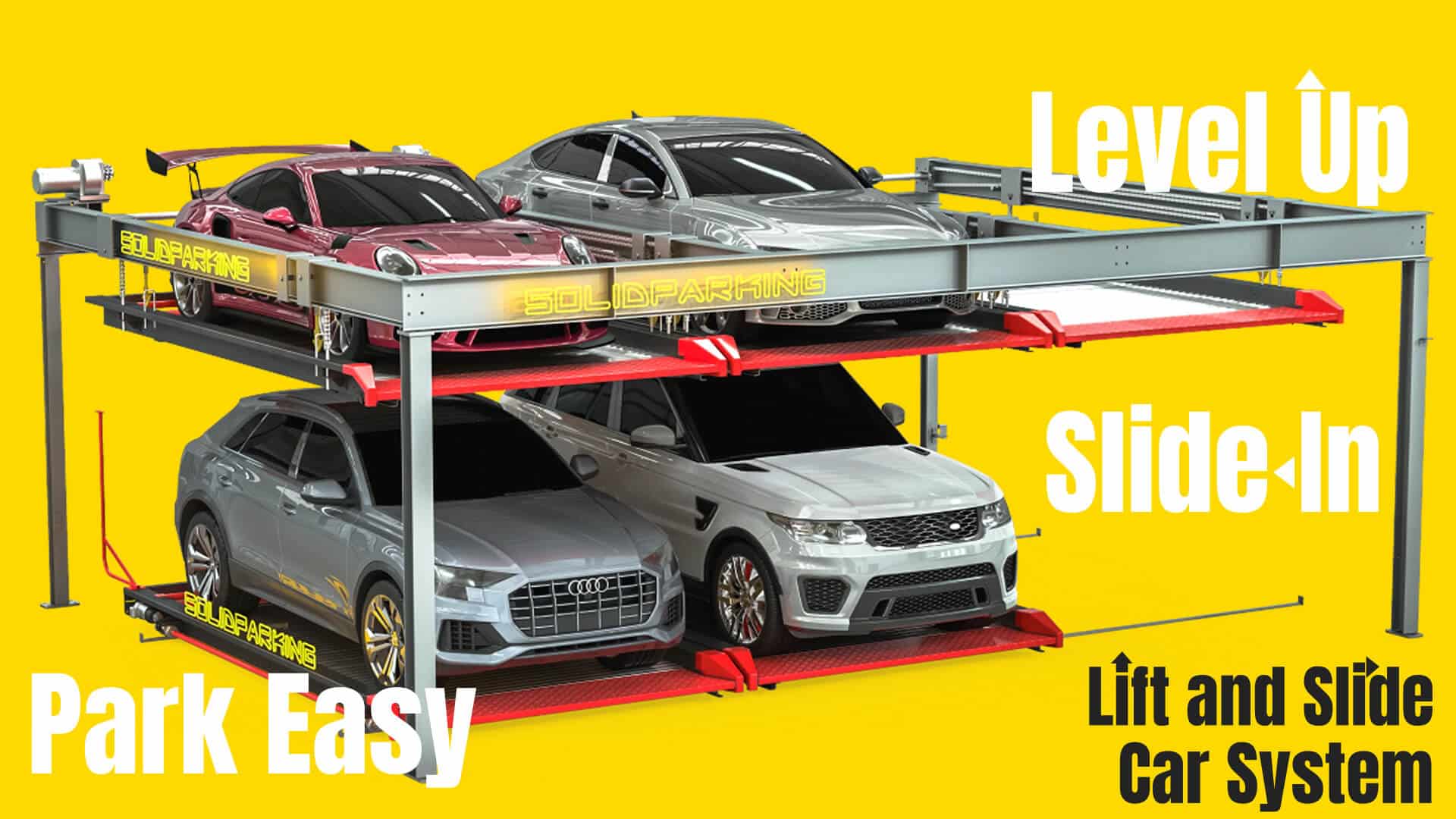
The lift and slide car system is a mechanical parking solution that combines vertical lifting and horizontal sliding of platforms to multiply parking capacity in a compact space.
Think of it as a three-dimensional puzzle:
· Lift: A platform raises or lowers a vehicle to a specific tier.
· Slide: The platform then shifts laterally, clearing access for additional cars.
By stacking vehicles vertically and arranging them side-by-side, this system can achieve 2–6 times the density of a conventional surface lot.
🔧Lecture Note: From an engineering standpoint, the critical challenge is synchronization — ensuring smooth transitions between lift and slide motions without mechanical interference.
Why Urban Areas Need Mechanical Lift and Slide Car Syetem Parking
Urbanization is accelerating. According to UN data, 68% of the world’s population will live in cities by 2050. This surge brings parking challenges:
· Land Scarcity: Surface parking consumes high-value urban plots.
· Construction Cost: Deep basements are expensive and disruptive.
· Traffic Pollution: Studies show up to 30% of inner-city traffic comes from drivers circling for parking.
The lift and slide car system addresses these pain points by:
· Lowering emissions by minimizing vehicle movement inside garages
📊Example: The SH Campus Puzzle Parking Systemdelivered a strong ROI by creating 17 parking spaces within a compact footprint, significantly reducing the cost per parking stall compared to traditional construction.
Its durable galvanized structure and low-maintenance operation ensure long-term value, minimizing lifecycle expenses while maximizing revenue potential.
· Speed vs. Comfort: Lifting speed must balance efficiency (0.1–0.15 m/s) with passenger comfort.
· Redundancy: Dual safety locks and backup drives are standard in premium systems.
Lift and Slide Car System Hydraulic vs. Electric Drives: A Comparative Analysis
The choice of drive system defines cost, performance, and long-term reliability.
Feature
Hydraulic Drive
Electric Drive
Load Capacity
High (up to 4,000 kg)
Moderate (up to 2,500 kg)
Smoothness
Excellent
Good
Maintenance
Requires fluid checks, seals
Chains/ropes require inspection
Cost
Higher upfront
Lower upfront
Best Use Case
Heavy SUVs, underground pits
Light sedans, cost-sensitive projects
📖Reference: A ResearchGate study(2024) demonstrated that hydraulics outperform electric drives in space-restricted urban environments due to their compact cylinders and high force density.
Meanwhile, Academia.edu researchhighlights the advantages of PLC-controlled electric lifts in improving reliability and precision.
Pit-Type Lift and Slide Car Systems
The pit-type lift and slide car system adds another dimension to efficiency by using subterranean pits.
How It Works
· A car parks on the ground-level platform.
· The platform descends into a pit, clearing the surface for another vehicle.
· Additional cars are stacked above using sliding lifts.
Advantages
· Preserves Surface Usability: Ground level remains open for pedestrians or additional cars.
· Aesthetic Integration: Cars are hidden underground, leaving clean courtyards.
· Height Restriction Compliance: Useful in residential zones with limited building height.
Engineering Challenges
· Drainage & Waterproofing: Pits must be sealed against groundwater infiltration.
· Soil Conditions: Poor soil may require piling or reinforcement.
· Safety Access: Emergency ladders and technician entry points are mandatory.
This approach is especially popular in luxury villas, boutique hotels, and urban plazas.
Industrial Case Studies and Global Practices of lift and slide car system
Mitsubishi Heavy Industries: Cell Park
A puzzle-style system where pallets move horizontally and vertically in a matrix.
Varies by region, but typically $8,000–$15,000 per parking space, depending on drive type and pit excavation.
The Road Ahead
The lift and slide car system is more than a parking technology — it is a strategic tool for reclaiming urban land.
· Hydraulic systems will dominate heavy-duty and pit-type designs.
· Electric systems will evolve with smart PLC control and AI optimization.
· Integration with EV charging and renewable energy storage will make these systems part of smart city infrastructure.
🔧Closing Lecture Note: As engineers and architects, our task is not just to park cars efficiently, but to design systems that harmonize with the urban ecosystem — balancing technology, safety, and sustainability.