Car Lift Dimensions Guide for Auto Lift Installations (2026)

2026-03-30
car lift dimension for auto lift

Introduction

Before installing an auto lift system, one question determines whether the project is even feasible:

Will the space properly accommodate the required car lift dimensions?

In this guide—Part 2 of The High-Density Masterclass: Scaling Your Parking in 2026—we break down the technical requirements needed to evaluate a site for installation.

If you’re just getting started, you can review Part 1 here:

The High-Density Masterclass-1: Space-Saving Car Stacker Solutions

Table of Contents

What Are Car Lift Dimensions?

They refer to the full spatial and structural requirements needed to install and operate a vehicle lift safely.

These include:

  • Ceiling height (vertical clearance)
  • Platform height and lift travel range
  • Vehicle height and width
  • Structural slab requirements
  • Clearance for operation and safety

Understanding these factors ensures the system fits, functions, and complies with engineering standards.

Why Car Lift Dimensions Matter

They directly affect:

  • Installation feasibility
  • Safety and compliance
  • System selection (sedan vs SUV systems)
  • Operational efficiency

If dimensions are underestimated, the system may:

  • Fail to install
  • Operate unsafely
  • Underperform in real-world use

Minimum Ceiling Height Requirements

Quick Reference Table

System TypeMinimum Ceiling Height
Sedan Auto Lift10.5 – 11 ft
SUV-Compatible Lift13.5 – 14 ft
Triple Stack Systems18+ ft

These values account for:

  • Vehicle height
  • Platform thickness
  • Lift mechanism travel
  • Safety clearance buffer

👉 Explore related system options

Vertical Clearance Breakdown

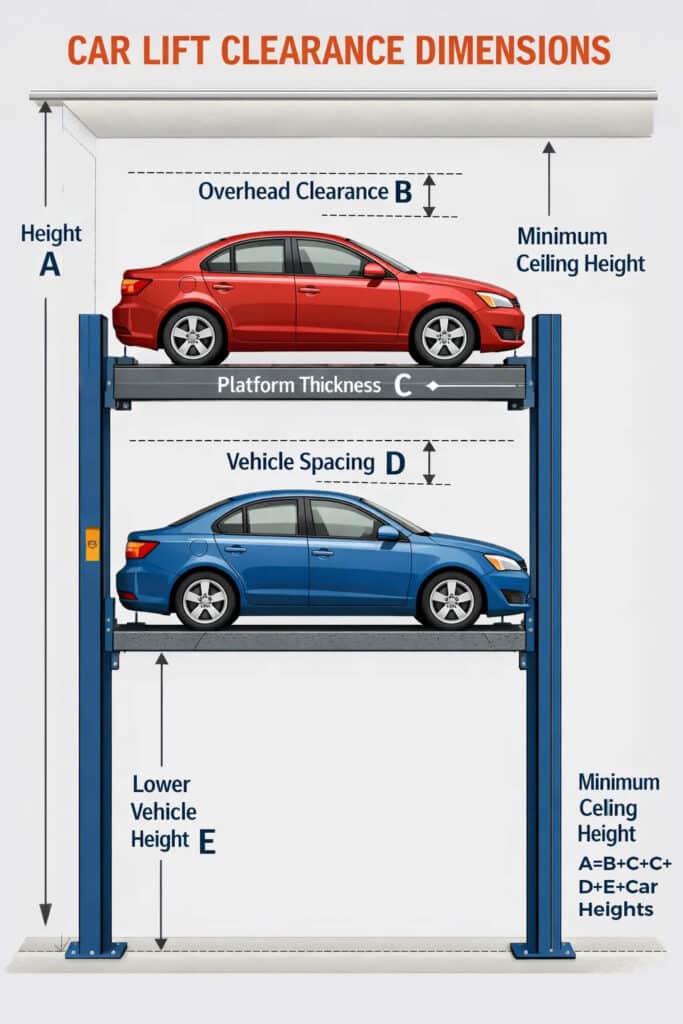
Vertical clearance diagram showing car lift dimensions including ceiling height, platform thickness, and vehicle spacing.
ComponentDescriptionTypical Range
Ceiling HeightTotal floor-to-ceiling measurement10.5 – 14+ ft
Obstruction ZoneBeams, ducts, sprinklers reducing usable space0.5 – 2 ft
Safety Clearance BufferRequired gap above top vehicle4 – 8 inches
Upper Vehicle HeightHeight of vehicle on upper platform4.5 – 6.5 ft
Platform ThicknessThickness of lift platform structure4 – 8 inches
Lower Vehicle HeightHeight of vehicle parked below4.5 – 6.5 ft

Configuration Fit Table (Real-World Application)

Usable HeightSuitable Configuration
< 10.5 ftNot suitable for stacking
10.5 – 11 ftSedan-over-sedan
12 – 13 ftSedan + mid-size SUV (limited cases)
13.5 – 14 ftFull SUV-compatible systems
18+ ftTriple stack systems

Technical Audit Checklist for Installation

A proper evaluation of car lift dimensions requires more than just measuring height.

✅ Site Measurement Checklist

  • Ceiling height measured to lowest obstruction
  • Obstructions identified (ducts, beams, sprinklers)

✅ Vehicle Profile

  • Maximum vehicle height defined
  • Sedan vs SUV mix determined

✅ Structural Evaluation

  • Concrete PSI verified
  • Slab thickness confirmed
  • Reinforcement assessed
  • Anchor capacity evaluated

✅ Layout & Flow

  • Turning radius adequate
  • Aisle width sufficient
  • Entry and exit paths clear

✅ Utilities

  • Electrical supply available
  • Control panel accessible
  • Emergency systems installed

Structural Requirements for Car Lift Installations

Auto lift systems must be anchored into reinforced concrete slabs capable of handling both static and dynamic loads.

Key considerations include:

  • Anchor embedment depth
  • Load distribution across base plates
  • Point load vs distributed load behavior
  • Structural reinforcement adequacy

These systems are designed and evaluated under standards aligned with organizations such as:  ANSI/ALI ALCTV:2017 – “Standard for Automotive Lifts – Safety Requirements for Construction, Testing and Validation

Operational Layout Considerations

Even if a system fits physically, usability depends on layout design.

Important factors:

  • Vehicle maneuvering space
  • Aisle width
  • Door clearance
  • Traffic flow
  • Interaction with adjacent parking spaces

Poor layout design can reduce throughput and operational efficiency.

Related Reading:

Parking solutions overview:

Increasing Property Value with Car Stacker Lift and Parking Solutions: A Guide for Real Estate Developers

ROI analysis:

Puzzle Parking vs Stack Parking: 3 Proven Reasons Puzzle Parking Delivers the Best ROI

Frequently Asked Questions

What are the typical car lift dimensions?

They vary by system, but most require 10.5–14 feet of ceiling height and sufficient slab strength depending on vehicle type and configuration.

Yes, but only if the structure meets required height, load, and layout conditions. A technical audit is recommended before installation.

Yes. Most systems must be anchored into reinforced concrete slabs with adequate PSI rating and thickness to ensure safe operation.

Conclusion

Auto lift car lift dimensions are the foundation of any successful installation.

Before selecting a system, ensure your site meets:

  • Ceiling height requirements
  • Structural load capacity
  • Layout and clearance needs
  • Safety and compliance standards
qrcode