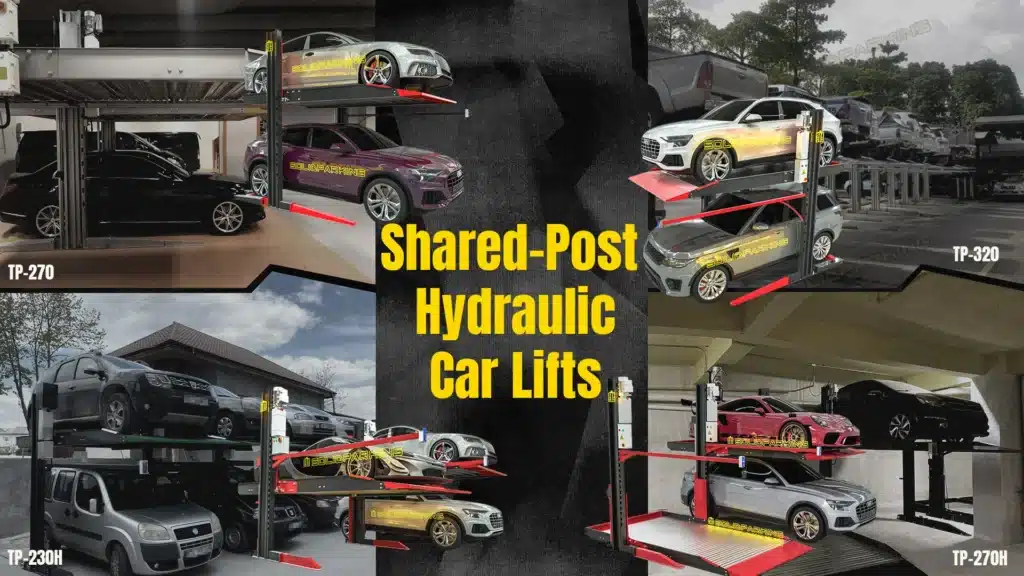
Shared-Post Hydraulic Car Lifts (Core Engineering System)
The defining innovation behind SolidParking two posts car lifts is the shared-post structural system, an engineering approach that transforms individual parking lifts into a unified, modular parking infrastructure.
Traditional hydraulic car lifts are typically designed as isolated units. Each parking module requires its own complete set of structural columns, foundations, and independent framing. While functional, this creates major inefficiencies in large residential and commercial parking projects.
These conventional systems often result in:
duplicated structural columns
excessive steel usage
larger foundation requirements
wasted circulation space
visual congestion inside garages
limited scalability for future expansion
SolidParking’s shared-post engineering system solves these problems by allowing adjacent two posts car lifts to share intermediate structural columns.
Instead of treating each parking lift as a separate machine, the system creates a continuous structural parking grid where multiple hydraulic lift modules work together as a connected framework.
What Shared-Post Design Changes
Removes duplicate structural columns
Reduces foundation cost per parking bay
Improves spatial efficiency
Creates modular expansion capability
Engineering Logic
Traditional system:
Lift A → independent columns → Lift B → independent columns
Shared-post system:
Lift A + shared structural node + Lift B (continuous load grid)
Architectural Benefits
Cleaner garage interiors
Improved lighting distribution
Reduced visual obstruction
Premium luxury appearance
Shared Posts 230H
Shared Posts 270H
Shared Posts 270
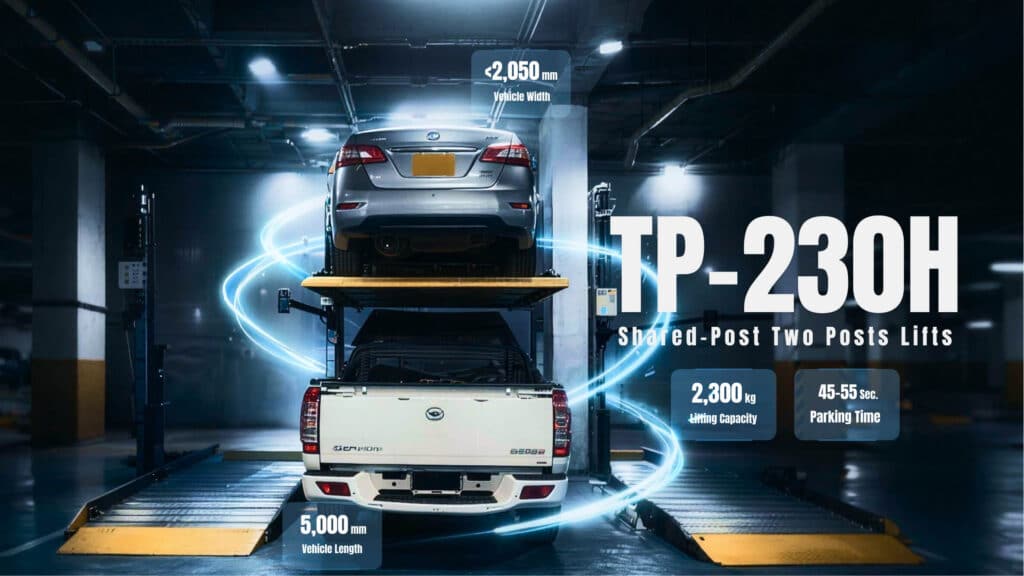
TP-230H — Urban Shared-Post Car Lifts
The TP-230H is designed for compact urban environments where every centimeter matters.
Shared-Post Design Application
Shares central columns between lift bays
Eliminates redundant side supports
Maximizes usable parking footprint
Benefits
Ideal for retrofits
High density parking
Minimal structural intrusion
Best Use Cases
Townhouses
Urban basements
Small residential developments
TP-270 — Residential Shared-Post Two Posts Car Lifts
The TP-270 is the balanced residential system for scalable housing projects.
Shared-Post Design Application
Modular grid-based structure
Repeating column-sharing system
Uniform load distribution
Benefits
Cost-efficient expansion
Structural consistency across buildings
Easy architectural integration
Best Use Cases
Apartment buildings
Villas
Mixed-use residential developments
TP-270H — Commercial Shared-Post Lifts
The TP-270H is built for high-frequency commercial operations.
Shared-Post Design Application
Continuous column-sharing across active lanes
Optimized for repeated hydraulic cycles
Supports valet and high-turnover systems
Benefits
High operational durability
Reduced maintenance points
Faster vehicle flow
Best Use Cases
Hotels
Shopping malls
Valet parking systems
Dealerships
TP-320 — Heavy-Duty Shared-Post Car Lifts
The TP-320 is the flagship system for luxury and EV-heavy environments.
Shared-Post Design Application
Reinforced shared columns for heavy loads
Structural grid optimized for EV weight distribution
Enhanced beam junction reinforcement
EV Compatibility
Supports vehicles such as:
Tesla Cybertruck
Rivian R1S
Lucid Gravity
Benefits
High load capacity
Future-ready EV infrastructure
Premium architectural integration
EV Adaptability in Hydraulic Car Lifts
Modern EVs require redesigned parking infrastructure.
Key EV Challenges
Increased vehicle weight
Larger platform dimensions
Flat battery underbodies
Hydraulic Lift Adaptations
Wider tire support platforms
Reinforced load distribution
Higher structural tolerance
EV-safe lifting geometry
Real Estate Value Impact
Two posts car lifts directly increase property value by:
improving parking efficiency
reducing land consumption
enhancing luxury perception
increasing ROI per square meter
They are now considered real estate performance assets, not just mechanical systems.
FAQ
1. What is a shared-post hydraulic car lift system?
A shared-post system allows multiple hydraulic car lifts to use common structural columns, reducing steel usage, lowering cost, and increasing parking density.
2. Are hydraulic car lifts suitable for EVs?
Yes. Modern hydraulic car lifts are designed to support EV weight, wider dimensions, and flat battery platforms found in vehicles like Tesla and Rivian models.
3. Which model is best for residential parking?
The TP-270 is the most balanced two posts car lift for residential developments due to its scalability and cost efficiency.
4. What is the best hydraulic car lift for luxury SUVs?
The TP-320 is the best option for luxury SUVs and EVs due to its higher load capacity and reinforced shared-post structure.
5. Do shared-post systems reduce construction cost?
Yes. Shared-post hydraulic car lifts reduce steel usage, foundation work, and installation time, lowering total project cost significantly.
Conclusion
The evolution is defined by one innovation: the shared-post structural system.
From TP-230H to TP-320, SolidParking delivers a scalable infrastructure model that:
maximizes parking efficiency
supports EV evolution
reduces construction cost
enhances architectural design value
increases real estate ROI
As urban density and EV adoption increase, shared-post hydraulic systems will become the foundation of modern parking architecture.