
Triple Stack Parking Lifts: 7 Real Reasons Why TTS-3 Hydraulic Car Lifts Are Growing Fast
Triple stack parking lift: Why More Buildings Are Quietly Going Vertical
Table of Contents
Parking Space Is Becoming More Expensive Than People Realize
Most people see a triple stacker parking system for the first time and think:
“Who actually needs this?”
Fair question.
Because if you already have enough parking space, a hydraulic car lift probably feels unnecessary.
But the moment parking becomes a business problem instead of a convenience problem, the conversation changes completely.
Especially when:
- land prices increase
- underground parking becomes too expensive
- buildings cannot expand outward
- parking requirements become stricter
- vehicle inventory keeps growing
That is usually when developers, collectors, and commercial property owners start looking upward instead of outward.
Not because vertical parking is trendy.
Because eventually, space becomes more expensive than the equipment itself.
If you are researching a triple stacker parking system or comparing different hydraulic car lifts, it helps to look beyond manufacturer brochures and understand how parking infrastructure is evolving globally.
For broader parking industry trends, urban parking economics, and structured parking discussions, the National Parking Association regularly publishes insights related to parking operations and development strategies.
What a Triple stack parking lift Actually Solves
A triple parking lift solves one very specific issue:
How do you fit more vehicles into the same footprint without rebuilding the property?
That is the real purpose behind systems like the TTS-3.
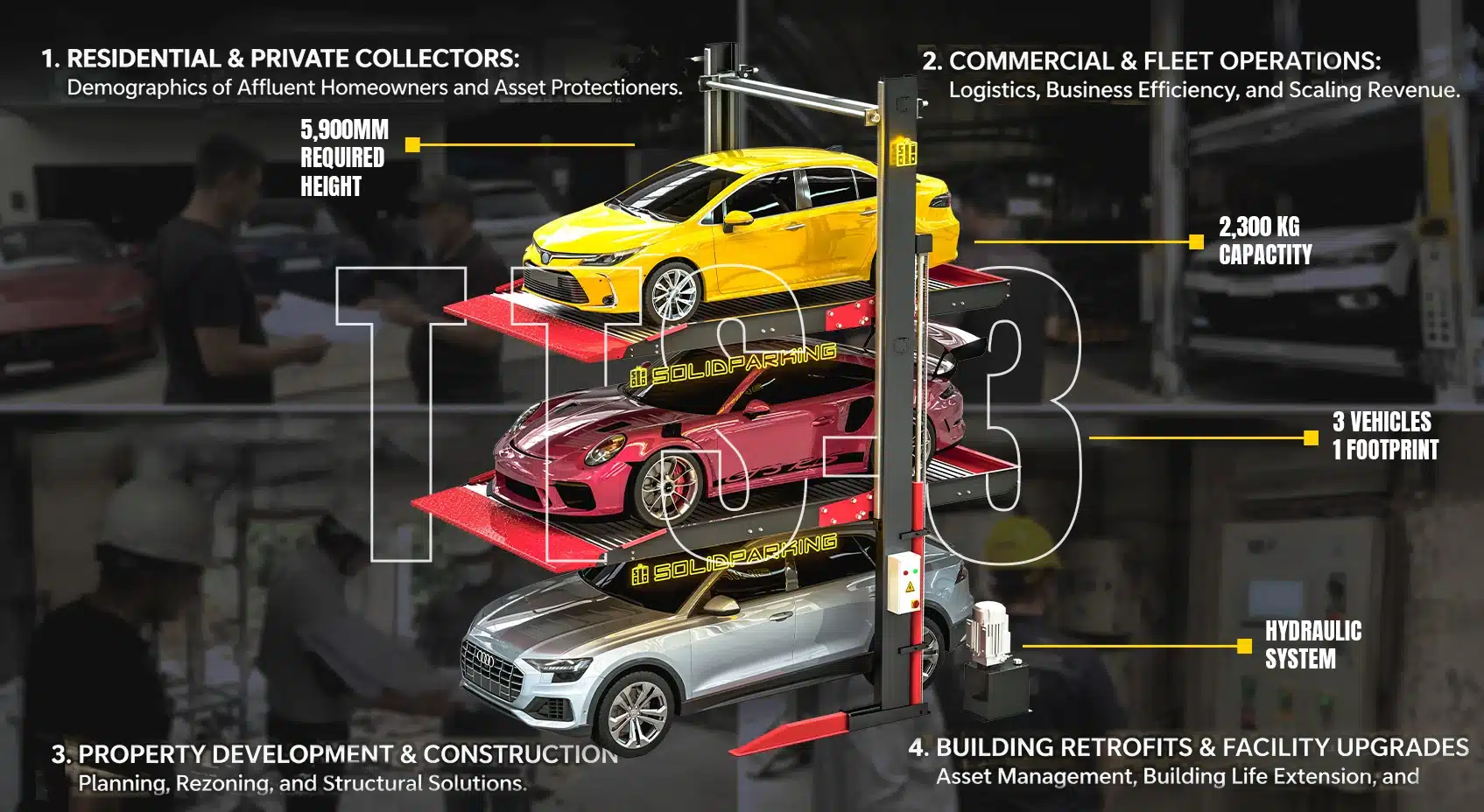
The TTS-3 is a two-post car lift designed to vertically stack three vehicles using hydraulic lifting and mechanical locking systems.
But buyers usually do not care about the machinery first.
They care about outcomes.
They want to know:
- Will this reduce expansion costs?
- Will this help recover unused vertical space?
- Will this increase parking capacity?
- Will this improve property usability?
- Will this delay expensive construction upgrades?
That is why the specifications only matter when connected to actual user needs.
Why Most People Misunderstand Hydraulic Car Lifts
A lot of people assume hydraulic car lifts are about convenience.
In reality, systems like the TTS-3 are usually purchased because the alternatives became financially painful.
For example:
A developer may need additional parking spaces to satisfy approval requirements.
A dealership may run out of indoor inventory storage.
A collector may not want to build another garage structure.
A retrofit building may physically have no room left to expand.
That is where hydraulic car lifts become practical.
Not luxurious.
Practical.
Because instead of:
- excavation
- structural expansion
- land acquisition
- major reconstruction
the building simply uses vertical clearance more efficiently.
That is the actual value proposition.
Who Really Benefits From the TTS-3?
This is where many parking lift articles become too generic.
Because honestly, not everybody should buy a triple stacker parking system.
But for the right users, it solves very expensive problems surprisingly well.
Quick Buyer Fit Table
| Who You Are | What Problem You Have | Why You Need It | How the TTS-3 Suits You |
|---|---|---|---|
| Luxury Car Collector | Running out of indoor garage space | Protect and store multiple vehicles without building another garage | Triple stacker parking lift stores 3 vehicles in one footprint while keeping cars indoors. |
| Urban Dealership | Overflow inventory and expensive showroom space | Increase vehicle storage density without expanding property | Hydraulic car lifts help organize inventory vertically and reduce overflow pressure. |
| Retrofit Building Owner | Old building with limited parking capacity | Improve parking ratio without reconstruction | Two-post car lifts use unused ceiling height efficiently. |
| Premium Homeowner | Multiple vehicles but limited garage area | Keep garage clean and maximize usable space | TTS-3 supports organized multi-vehicle storage in luxury garages. |
| Commercial Storage Operator | Need higher vehicle storage efficiency | Increase storage revenue per square meter | Triple stack parking lift improves parking density dramatically. |
| Mixed-Use Developer | Parking requirements blocking approvals | Add parking capacity without excavation | Vertical parking system reduces expansion costs and saves footprint. |
| EV Owner | Heavy modern vehicles | Need higher lifting capacity for future vehicle trends | 2300kg hydraulic car lift capacity supports many SUVs and EVs. |
Luxury Vehicle Collectors
Collectors are one of the clearest use cases.
Why?
Because collectors usually prioritize:
- vehicle preservation
- indoor storage
- organized inventory
- maximizing garage capacity
—not rapid daily retrieval.
Many collector vehicles:
- stay parked long-term
- rotate seasonally
- are driven occasionally
So the TTS-3 helps them:
- store more vehicles indoors
- avoid building additional garages
- reduce off-site storage dependency
- keep collections centralized
The three-level stacking design matters because one parking footprint suddenly becomes three protected storage spaces.
For collectors in expensive urban properties, that changes everything.
Dealerships and Automotive Storage Facilities
Dealerships benefit differently.
Their problem is usually inventory pressure.
Especially in urban locations where:
- showroom space is expensive
- overflow inventory becomes messy
- indoor storage is limited
The TTS-3 helps dealerships:
- increase indoor vehicle density
- organize inventory vertically
- reduce overflow parking stress
- maximize warehouse efficiency
And this is where the hydraulic system becomes important operationally.
Because dealership staff can move vehicles systematically instead of relying on expensive building expansion.
The two-post car lift structure also helps maintain a cleaner visual appearance compared to bulkier parking systems.
That matters more than people think in premium automotive environments.
And for dealership operators evaluating vertical inventory storage solutions, the National Automobile Dealers Association frequently discusses operational challenges affecting modern automotive retail environments.
Retrofit Commercial Buildings
Older buildings often face impossible parking situations.
Especially mixed-use and commercial properties built decades ago.
Many now struggle with:
- insufficient parking ratios
- fixed structural footprints
- zoning limitations
- rising tenant expectations
But they still have unused ceiling height.
That is exactly where a triple stacker parking system becomes valuable.
Instead of rebuilding the structure, the property owner converts vertical clearance into usable parking capacity.
This helps:
- improve building usability
- increase tenant satisfaction
- support higher occupancy
- avoid major reconstruction costs
For retrofit projects, this can dramatically improve project feasibility.
For technical building considerations involving structural integration, ventilation, and retrofit planning, the Whole Building Design Guide contains valuable engineering and facility planning references.
Premium Residential Projects
Luxury residential developments increasingly face parking pressure too.
Especially in cities where:
- parking space is limited
- buyers own multiple vehicles
- underground expansion is expensive
For premium homeowners, hydraulic car lifts help:
- maximize garage functionality
- preserve architectural footprint
- support multi-vehicle ownership
- maintain cleaner garage organization
And because many luxury homeowners use secondary vehicles less frequently, dependent parking becomes more acceptable operationally.
Why the Specifications Actually Matter to Real Buyers
Most parking lift articles throw specifications at readers without explaining why they matter.
But buyers usually care less about numbers and more about what those numbers allow them to do.
Why 2300kg Capacity Matters
Modern vehicles are getting heavier every year.
Especially:
- SUVs
- EVs
- luxury crossovers
A 2300kg platform capacity means buyers can safely store:
- larger family SUVs
- premium electric vehicles
- heavier luxury models
Without constantly worrying about weight limitations.
For commercial buyers, this also protects long-term usability because vehicle trends continue moving heavier.
Since modern EVs and SUVs continue increasing vehicle weight requirements for hydraulic car lifts, the U.S. Department of Energy also provides useful information regarding electric vehicle infrastructure and transportation trends.
Why Hydraulic Lifting Matters
Hydraulic car lifts are popular because they provide:
- smoother lifting
- controlled movement
- reliable vertical operation
- lower operational complexity
For users, this translates into:
- easier daily operation
- reduced mechanical stress
- better long-term reliability perception
Most buyers may not understand hydraulic engineering deeply.
But they absolutely notice smoothness and stability during operation.
Why Mechanical Safety Locks Matter
This is probably one of the most psychologically important features.
Because buyers always ask:
“What happens if power fails or hydraulics stop working?”
Mechanical safety locks physically secure the platforms independently from the hydraulic system.
That creates:
- stronger trust
- safer long-term storage
- better confidence for luxury vehicles
- improved user comfort
Especially for collectors and commercial operators storing high-value inventory.
Why the Two-Post Structure Matters
The two-post car lift design matters because it creates:
- a cleaner appearance
- easier retrofit flexibility
- less visual bulk
- better architectural integration
This becomes important in:
- luxury garages
- premium dealerships
- visible parking environments
Because buyers increasingly care about aesthetics alongside functionality.
The Truth About Dependent Parking Systems
This is the part many manufacturers avoid discussing honestly.
The TTS-3 is a dependent parking system.
Meaning:
- vehicles are retrieved sequentially
- upper platforms may need to move before lower vehicles exit
For high-turnover public parking?
Probably frustrating.
But for:
- collectors
- dealerships
- overflow storage
- low-frequency parking
the tradeoff becomes much more reasonable.
And honestly, buyers usually appreciate transparency more than exaggerated marketing promises.
Most Asked FAQs
Is the TTS-3 suitable for daily-use family parking?
Not usually.
The TTS-3 works best for low-frequency or organized vehicle storage rather than constant random retrieval.
What ceiling height is required for a triple stacker parking system?
Most installations require approximately 5900mm of vertical clearance.
Can hydraulic car lifts support SUVs and EVs?
Yes.
The TTS-3 supports up to 2300kg per platform, making it suitable for many SUVs and electric vehicles.
Are two-post car lifts safe for long-term storage?
Yes, especially when combined with mechanical safety locks like the TTS-3 system uses.
Is the TTS-3 better than underground parking expansion?
In many retrofit or high-cost urban projects, yes.
Vertical parking systems can be significantly cheaper than excavation and structural expansion.
Who benefits most from a triple stack parking lift?
Typically:
- collectors
- dealerships
- retrofit buildings
- premium residential garages
- commercial vehicle storage operators
Why Developers Are Looking at Vertical Parking Again
Construction costs continue rising globally.
Especially:
- excavation
- underground parking
- structural reinforcement
- ventilation systems
- waterproofing
At the same time, urban density keeps increasing.
Urban Land Institute research continues highlighting how cities are adapting parking strategies around land efficiency and retrofit flexibility.
That is why vertical parking systems are becoming relevant again.
Not because they are futuristic.
Because in many projects:
vertical expansion becomes cheaper than physical expansion.
And once that happens, hydraulic car lifts stop feeling excessive and start feeling financially logical.
Final Thoughts
The TTS-3 is not trying to solve every parking problem.
And honestly, that is probably why it makes more sense than many over-marketed parking systems.
It works best for people facing a very specific issue:
Needing more parking capacity without rebuilding the property.
For:
- collectors
- dealerships
- retrofit buildings
- premium residential garages
- commercial storage operations
that can become an extremely practical investment.
Especially when compared against:
- construction expansion
- underground excavation
- land acquisition
- losing rentable space
At the end of the day, the TTS-3 is not really about machinery.
It is about helping buildings adapt to increasingly expensive space.
And in dense cities, that problem is only becoming more common.