
2 Post vs 4 Post Lift for Storage: The Ultimate Smart Buyer Guide for EV-Compatible Car Lifts in 2026
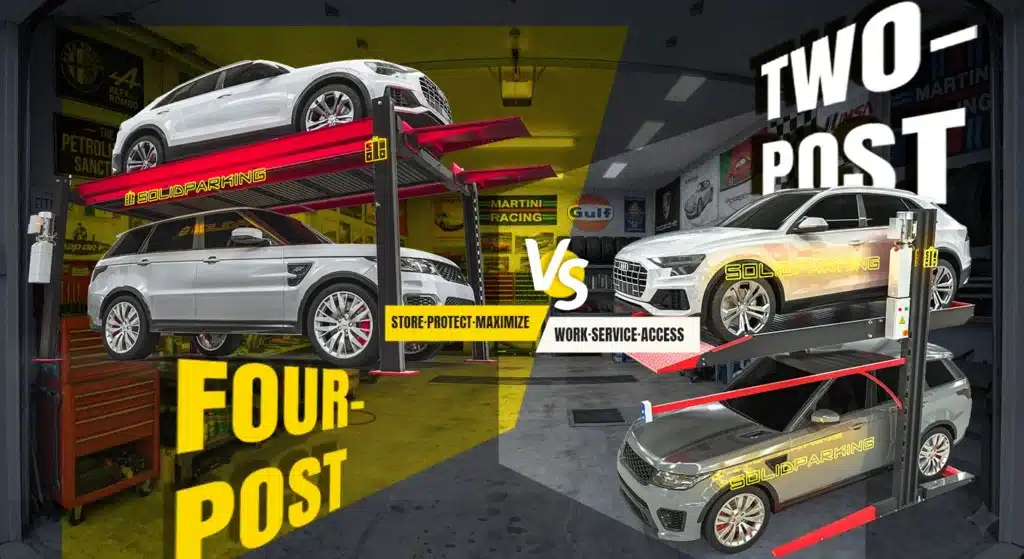
A practical buyer guide to 2 post vs 4 post lift for storage, EV-compatible car lifts, and what enthusiasts actually learn too late
Most people don’t start researching garage lifts because they suddenly became interested in hydraulics.
This is why early-stage buyers spend hours reading car lift reviews, watching installation videos, and scrolling through enthusiast communities like The Garage Journal Forum to see how real-world setups handle specific garage ceiling heights and concrete configurations.
Then eventually, somewhere between YouTube installs, Reddit threads, and reading dozens of car lift reviews late at night, the same search appears:
“2 post vs 4 post lift for storage.”
At first, it sounds like a technical comparison.
But after watching how most buyers actually go through this process, the decision usually has less to do with lifting cars…
And more to do with:
- space pressure
- future vehicles
- convenience
- long-term regret
- how the garage actually gets used every day
That’s why so many buyers feel overwhelmed halfway through research.
They are trying to solve a lifestyle problem using equipment specifications.
Start Here: What Problem Are You Actually Trying to Solve?
Before comparing brands or capacities, this is usually the most important question.
Because buyers who answer this honestly tend to make decisions much faster.
| Your Actual Situation | Usually Better Fit | Why It Works |
|---|---|---|
| You actively work underneath vehicles | 2-post lift | Full underbody access makes repairs and maintenance easier. |
| You mainly need more parking space | 4-post lift | Designed primarily for efficient vehicle storage and stacking. |
| You own heavier EVs or large SUVs | Higher-capacity systems | Supports increased vehicle weight safely and reliably. |
| You want easier daily operation | 4-post lift | Drive-on design reduces setup time and effort. |
| You prioritize wheel and suspension access | 2-post lift | Frees wheels for suspension, brake, and tire work. |
| You dislike positioning lift arms | 4-post lift | No arm placement needed—just drive on and lift. |
| You plan to keep the lift long-term | Future-proof capacity matters more | Higher capacity ensures compatibility with future vehicle changes. |
Most buying confusion starts when people try to force one lift type to solve both problems equally.
In reality, they rarely do.
Why Buyers Initially Lean Toward 2-Post Lifts
Most enthusiasts begin here.
A two-post lift feels serious.
It looks like:
- a professional workshop
- a performance garage
- a “real enthusiast” setup
And for buyers who genuinely work on cars often, that instinct is correct.
A good 2-post lift provides:
- full underbody access
- brake access
- suspension access
- easier maintenance
- unrestricted wheel removal
That’s why enthusiasts who:
- track cars
- modify suspension
- restore vehicles
- perform their own maintenance
still overwhelmingly prefer two-post systems.
But this is also where many homeowners hit an unexpected realization:
They spend more time organizing cars than repairing them.
That realization changes the buying direction completely.
Why So Many Buyers Eventually Drift Toward 4-Post Storage Lifts
This is the point most comparison articles miss.
Four-post lifts are not really competing against workshops.
They are competing against:
- garage clutter
- driveway parking
- limited home space
- expensive home additions
That’s why many buyers eventually realize:
they are not building a repair shop.
They are trying to recover space.
And psychologically, 4-post lifts feel very different.
You drive on.
You lift.
You gain another parking spot.
No swing-arm positioning.
No lift-point anxiety.
No constant adjustment.
For first-time buyers especially, that simplicity removes a huge amount of hesitation.
2 Post vs 4 Post Lift for Storage: The Simplest Decision Framework
If you’re stuck, this usually helps clarify things quickly.
Choose a 2-post lift if:
- you genuinely enjoy mechanical work
- you expect frequent underbody access
- you modify or service vehicles regularly
- your garage functions like a workshop
Choose a 4-post lift if:
- your main frustration is parking space
- you own multiple daily drivers
- other family members use the garage
- you want the easiest day-to-day experience
- storage matters more than repair access
This single distinction resolves most buying confusion surprisingly fast.
Where EV-Compatible Car Lifts Changed Buyer Priorities
Modern EVs and SUVs quietly changed the entire lift market.
A few years ago, many buyers only considered:
- sports cars
- sedans
- smaller SUVs
Now buyers worry about:
- Tesla Model X dimensions
- Rivian R1S weight
- oversized EV SUVs
- long wheelbases
- heavier battery platforms
This is why EV-compatible car lifts became a major discussion topic in enthusiast communities.
People are no longer asking:
“Can this lift my current car?”
They are asking:
“Will this still work for my next vehicle?”
That subtle difference is eliminating many smaller-capacity lifts immediately.
Especially among buyers planning long-term garage setups.
Buyers Usually Eliminate 2-Post Lifts When…
This is where hesitation commonly appears.
| Common Concern | Why Buyers Hesitate |
|---|---|
| Ceiling height feels borderline | They fear limited lifting usability and reduced operational flexibility. |
| Storage matters more than repairs | Full underbody access becomes less valuable compared to parking efficiency. |
| Family members also use the garage | Simplicity and ease of use become more important than technical capability. |
| They dislike positioning lift arms | Daily use feels intimidating or inconvenient, especially for non-technical users. |
| They mainly want another parking space | A 4-post system solves the problem more directly and with less complexity. |
Again, the issue is rarely quality.
It’s alignment with how the garage actually gets used.
Where Buyers Start Thinking Differently About SolidParking
For Buyers Leaning Toward 2-Post Lifts
TP-270 — When Buyers Want Their First “Real” Garage Upgrade
This usually appeals to:
- first-time lift buyers
- moderate DIY enthusiasts
- sports car owners
- homeowners testing workshop functionality
The attraction is less about extreme specs…
And more about:
“This feels manageable without feeling temporary.”
TP-320 — Where Many EV and SUV Buyers Eventually Land
This is where buyer psychology changes noticeably.
Instead of optimizing for:
today’s vehicle
buyers begin optimizing for:
future vehicles.
That’s why many enthusiasts skip smaller lifts entirely once they start thinking about:
- EV weight growth
- larger SUVs
- long-term ownership
- avoiding future upgrades
TP-320 fits that mindset because it removes one of the biggest buyer anxieties:
“Will I outgrow this lift later?”
For Buyers Leaning Toward 4-Post Storage Lifts
FP-360 — When Buyers Realize the Problem Is Space
Most homeowners do not initially search for storage systems.
They search because the garage stopped functioning smoothly.
FP-360 starts making sense when buyers realize:
expanding upward is cheaper than expanding outward.
And for many households, that realization changes the entire buying direction.
FP-360X — When Modern SUVs Start Feeling Huge
This is usually where buyers:
- own wider vehicles
- want easier parking comfort
- dislike tight platform clearance
- expect larger future vehicles
The appeal is less about technical capability…
And more about reducing daily friction.
What Buyers Most Commonly Regret Later
After reading enough car lift reviews and enthusiast discussions, the same patterns appear repeatedly.
Regret #1
Buying based only on the current vehicle.
Regret #2
Underestimating SUV size growth.
Regret #3
Buying a workshop lift when the real issue was storage.
Regret #4
Choosing the cheapest option without considering long-term use.
Interestingly, very few buyers regret:
- extra capacity
- extra width
- easier usability
But many regret buying too small too early.
What Buyers Usually Regret Later
After reading hundreds of enthusiast discussions and car lift reviews, the same regrets appear repeatedly:
Regret #1
Buying based only on today’s vehicle.
Regret #2
Underestimating SUV width and height.
Regret #3
Buying a workshop lift when the real problem was storage.
Regret #4
Choosing the cheapest lift without thinking long-term.
Interestingly, very few people regret buying “too much capacity.”
But many regret buying too little.
Final Buying Shortcut
If you still feel stuck, this usually simplifies the decision quickly.
| If Your Main Goal Is… | Usually Better Choice |
|---|---|
| Working underneath vehicles | 2-post lift |
| Recovering garage space | 4-post lift |
| Future EV compatibility | Higher-capacity system |
| Easier daily parking | 4-post lift |
| Suspension and brake access | 2-post lift |
| Long-term flexibility | Larger-capacity models |
| Stress-free storage | 4-post lift |
Because by the end of the buying process, most people realize:
The real decision was never:
“Which lift is better?”
It was:
“What kind of garage experience do I actually want every day?”
And once buyers answer that honestly, the right direction usually becomes much clearer.
FAQs (Decision Help Section)
1. Is a 2-post or 4-post lift better for storage?
A 4-post lift is generally the better choice for long-term storage. The vehicle is driven onto full-length runways, keeping the suspension in a natural, unloaded state, which is ideal for extended parking. A 2-post lift is better suited for maintenance work, but it is not recommended for leaving vehicles suspended for long periods due to suspension and load distribution considerations.
2. Are EV-compatible car lifts strictly necessary?
Yes, especially for modern EVs and heavier SUVs. EVs place significantly higher loads due to battery weight, so higher-capacity lifts are essential for safety and stability. Wider vehicles also benefit from broader runways and optimized column spacing to reduce risks such as door impact and tire sidewall contact during loading.
3. Do I need special concrete for a car lift?
For most 2-post lifts, yes. A reinforced concrete slab (typically at least 4 inches thick, and often 6 inches for heavier-duty models, rated around 3000 PSI or higher) is required because the posts concentrate load into small points. 4-post lifts distribute weight across a wider footprint, so they are often more forgiving and can typically be installed on standard residential garage slabs, depending on condition and specifications.
4. Can a 2-post lift be used for storage?
Yes, but it requires careful positioning every time. The vehicle must be aligned precisely with the lift arms at designated jacking points, which can be inconvenient for frequent use. For users prioritizing convenience and repeat daily parking, a 4-post drive-on system is typically the more practical option.
5. What is the safest option for beginners?
A 4-post lift is usually preferred for beginners. Its drive-on design feels more intuitive, requires no arm positioning, and provides a more stable visual and physical setup. This reduces user error and makes it more suitable for households where multiple drivers may use the system.