
Car Turntable: A Practical Guide to Driveways, Garages, and Showrooms

A car turntable looks simple: a rotating platform that turns a vehicle around a fixed point.
But the reason people install one is rarely just because they want a rotating platform.
In most cases, the problem is space.
A driveway may be wide enough to park a car but not wide enough to turn it around. A garage may have enough room for the vehicle itself but not enough maneuvering space around it. A showroom may need to reposition a vehicle repeatedly without driving it in and out of the display area.
This is where a car turntable becomes useful.
Instead of asking the vehicle to complete a large turning maneuver, the platform rotates the vehicle itself.
For residential driveways, private garages, dealerships, and vehicle showrooms, this can simplify vehicle movement while making better use of the available space.
What Is a Car Turntable?
A car turntable is a motorized rotating platform designed to rotate a vehicle around a central axis.
The vehicle drives onto the platform, stops in a suitable position, and the platform rotates to change the vehicle’s direction.
Depending on the application, a car turntable can be used for:
- Residential driveways
- Private garages
- Narrow access areas
- Vehicle dealerships
- Automotive showrooms
- Vehicle display areas
- Commercial parking environments
The important distinction is that a car turntable is not primarily a parking space expansion product.
Its main function is vehicle rotation and maneuverability.
Car Turn Table: 5 Key Ways a Car Rotating Platform Transforms Your Garage
That makes it particularly useful when the available area is adequate for the vehicle but inadequate for conventional turning.
Car turn table for Residential Use. Solution for narrow driveway.
Car turn table for Commercial Use. Solution for limited space.
Why Would You Need a Car Turntable?
Imagine a typical driveway.
There is enough space for a vehicle to enter and park, but the property layout does not leave enough room for a comfortable three-point turn.
The driver may have to reverse, move forward, reverse again, and make several steering corrections before the vehicle is facing the right direction.
This can be inconvenient in a normal passenger car and even more difficult with a large SUV or pickup truck.
A car turntable changes the maneuver.
Instead of using the vehicle’s turning radius, the driver positions the vehicle on the rotating platform and lets the platform handle the rotation.
The same principle applies to showrooms.
A vehicle that needs to be presented from different angles can rotate on the platform without repeatedly driving it out of the display area.
So while the equipment itself is mechanical, the problem it solves is fundamentally about space planning.
Car Turntable Specifications: What Actually Matters?
When comparing a car turntable, it is easy to focus on the diameter or appearance of the platform.
Those are important, but they are not enough.
A proper specification review should consider the complete installation.
For the CTT configuration shown in the reference, the main specifications are:
| Specification | CTT Reference |
|---|---|
| Total Footprint | 5.05 m |
| Turn Surface | 4 m |
| Turning Speed | 0.2–2 circles/min |
| Voltage | Customizable |
| Installation | Surface-mounted or pit-mounted |
| Control | Programmable wireless remote |
| Construction | Stainless steel |
| Power | Standard wall outlet power |
| Operation | Quiet operation |
| Mobility | 100% movable |
These numbers provide a starting point, but they should always be evaluated together with the actual vehicle and site layout.
OSHA Machine Guarding — useful reference for rotating machinery and moving-part safety. OSHA Machine Guarding
U.S. Access Board — parking and accessibility requirements for projects involving accessible parking. U.S. Access Board Parking Guidance
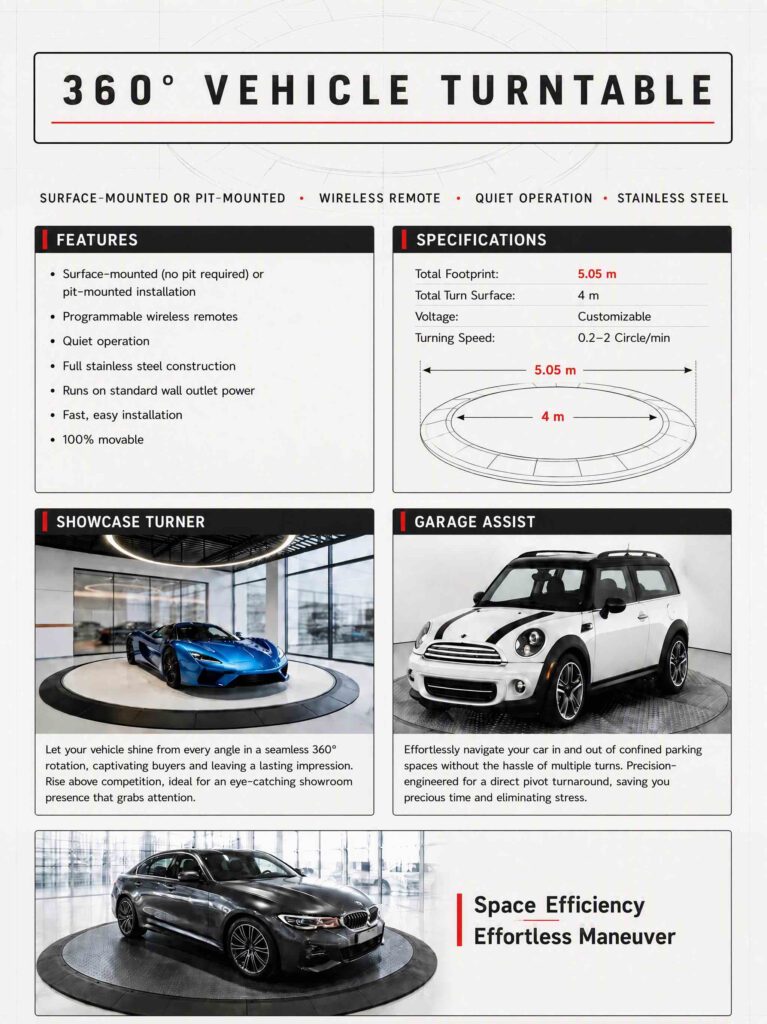
The 4 m Turn Surface Does Not Mean You Only Need 4 m of Space
This is one of the most important points when planning a car turntable.
The reference unit has a 4 m turn surface, while the total equipment footprint is approximately 5.05 m.
These are two different measurements.
The 4 m dimension describes the main rotating surface.
The 5.05 m figure represents the larger footprint of the equipment.
In a real installation, the required area can be larger still.
For example, the designer may need to account for:
- Vehicle approach
- Vehicle departure
- Walls
- Columns
- Garage doors
- Driveway boundaries
- Pedestrian circulation
- Vehicle mirrors
- Door clearance
- Front and rear overhang
This is why a turntable should never be specified by diameter alone.
The correct question is not:
“Will a 4 m turntable fit?”
It is:
“Will the vehicle, turntable, and surrounding clearances work together in this specific layout?”
That is a much more useful way to approach the design.
How to Choose a Driveway Car Turntable
A driveway car turntable makes the most sense when conventional maneuvering is difficult.
Common situations include narrow residential driveways, properties with walls or landscaping close to the vehicle path, and garages that provide enough parking space but very limited turning space.
Before selecting a system, start with the largest vehicle that will regularly use the driveway.
At minimum, check:
Vehicle length
A longer vehicle may require more consideration for platform positioning and approach clearance.
Vehicle width
Vehicle width matters not only for platform support, but also for surrounding clearance.
Wheelbase and overhang
Two vehicles with similar overall dimensions can behave differently because their wheelbase and front/rear overhangs are different.
Approach direction
The vehicle still needs a practical way to enter the platform.
Exit direction
Think about where the vehicle needs to face after rotation.
The goal is not simply to fit a vehicle onto the platform.
The goal is to create a complete and usable vehicle path.
Surface-Mounted or Pit-Mounted?
Another major decision is how the car turntable is installed.
The CTT configuration supports both surface-mounted and pit-mounted installation.
Surface-Mounted Car Turntable
A surface-mounted car turntable is installed on top of the prepared finished surface.
The biggest advantage is relatively straightforward installation.
There is no need to excavate a recessed pit for the rotating platform, which can make this configuration attractive for retrofit projects.
This can be particularly useful in:
- Existing garages
- Existing driveways
- Showrooms undergoing renovation
- Projects where civil work needs to be minimized
Surface-mounted systems can also be useful when future relocation or layout changes are possible.
However, the platform itself remains part of the floor environment, so the surrounding transition and edge condition should be considered during the layout stage.
Pit-Mounted Car Turntable
A pit-mounted car turntable is integrated into a recessed area in the floor.
The main advantage is a more integrated appearance.
When the project is designed around the turntable from the beginning, the platform can be incorporated into the finished floor more seamlessly.
This makes pit-mounted systems particularly interesting for:
- Luxury residential garages
- Premium showrooms
- Architectural projects
- Permanent installations
The trade-off is that pit installation requires additional construction planning.
Before installation, the project should consider:
- Pit dimensions
- Structural requirements
- Drainage
- Waterproofing
- Finished floor level
- Electrical routing
- Maintenance access
For that reason, pit-mounted installation is usually easier to plan during the early design stage.
Car Turntable for Showroom Applications
A car turntable for showroom use serves a slightly different purpose from a driveway system.
In a driveway, the main goal is maneuverability.
In a showroom, the platform can become part of the presentation.
A rotating vehicle can be viewed from multiple angles without requiring staff to repeatedly drive the vehicle in and out.
This can be useful for:
- Luxury vehicles
- Sports cars
- New vehicle launches
- Dealership displays
- Automotive exhibitions
- Premium vehicle presentations
The CTT reference configuration specifies a turning speed of 0.2–2 circles per minute.
That range is useful because showroom rotation does not necessarily need to be fast.
In many cases, slower movement provides a better visual experience and allows visitors to observe the vehicle more comfortably.
The same applies to noise.
The reference configuration emphasizes quiet operation, which can matter in a showroom where conversations, presentations, and customer interaction are part of the environment.
Why Wireless Control Matters More Than It Seems
The CTT configuration uses a programmable wireless remote.
That sounds like a small convenience feature, but it becomes more useful in real-world operation.
An operator does not necessarily need to stand directly beside the equipment to control the rotation.
For a driveway application, that can simplify vehicle positioning.
For a showroom, it can allow staff to control the display while remaining closer to the customer or demonstration area.
The important point is not simply that the system has a remote.
It is that the control method should match how the turntable will actually be used.
How Much Space Does a Car Turntable Need?
There is no single answer because the required area depends on both the equipment and the vehicle.
The reference CTT configuration has:
4 m turn surface
and
5.05 m total footprint
But those figures should be treated as equipment dimensions, not as the complete site requirement.
A practical layout should include:
Turntable footprint + vehicle clearance + approach area + departure area
The required clearance will depend on the vehicle and surrounding environment.
A small sedan in an open driveway has very different requirements from a large SUV in a garage surrounded by walls and columns.
For this reason, site drawings are much more useful than a single dimension when deciding whether a car turntable is appropriate.
A Better Way to Plan a Car Turntable
Before choosing a model, work through the project in this order.
Start with the vehicle
Identify the largest vehicle that will use the system regularly.
Record its:
- Length
- Width
- Wheelbase
- Front overhang
- Rear overhang
Then measure the site
Measure:
- Available width
- Available length
- Garage or driveway boundaries
- Wall positions
- Columns
- Door openings
- Entry and exit directions
Then choose the installation method
Ask whether the project is better suited to:
Surface-mounted installation
or
Pit-mounted installation
Finally, check the complete vehicle path
This is the step that is often overlooked.
The vehicle needs to get onto the platform, rotate safely, and leave the platform without conflicting with walls, doors, columns, or other obstacles.
The turntable itself may fit perfectly while the overall maneuver still does not work.
That is why layout planning should come before final equipment selection.
Car Turntable vs. Conventional Turning Space
A car turntable does not eliminate the need for space.
It changes how that space is used.
With conventional maneuvering, the vehicle needs enough open area to create its turning radius.
With a turntable, the vehicle can rotate around a fixed central axis.
This makes a turntable particularly useful where:
- The driveway is narrow
- A vehicle needs to leave in a specific direction
- Reversing is difficult
- A garage has restricted maneuvering space
- A showroom needs repeated vehicle repositioning
It is therefore better to think of a car turntable as a space-management tool, not simply as a rotating piece of equipment.
When a Car Turntable Makes Sense
A car turntable is worth considering when the main limitation of the site is maneuverability rather than parking capacity.
For a residential property, this might mean a driveway that can accommodate the vehicle but does not provide enough room to turn it comfortably.
For a showroom, the problem may be repeated vehicle repositioning.
For a commercial site, the objective may be controlling the orientation of vehicles in a constrained area.
In all three cases, the same principle applies:
Use mechanical rotation when there is not enough room for conventional vehicle rotation.
Safety and Operating Considerations
ecause a car turntable contains moving mechanical components, safety should be considered from the beginning of the project.
The final installation should address areas such as:
- Operator visibility
- Control access
- Emergency stopping procedures
- Moving-part protection
- Clear operating zones
- Maintenance access
- Interaction between pedestrians and moving equipment
For U.S. workplace environments, OSHA’s machine-guarding guidance provides useful reference material regarding rotating machinery and moving mechanical components.
For projects that also involve accessible parking, the turntable should be incorporated into the overall parking and access plan rather than treated as an isolated piece of equipment.
The exact safety requirements will depend on the application, installation environment, and local regulations.
The Real Question Is Not "How Big Is the Turntable?"
It is tempting to compare turntables by one number:
diameter.
But diameter is only part of the equation.
A practical evaluation should consider at least five things:
Vehicle size
What is the largest vehicle using the system?
Equipment footprint
How much space does the complete turntable occupy?
Surrounding clearance
What is around the platform?
Installation method
Will the system be surface-mounted or pit-mounted?
Actual vehicle path
Can the vehicle enter, rotate, and leave without creating conflicts?
The reference CTT specification of a 4 m turn surface and 5.05 m total footprint provides a useful example of why these two dimensions need to be considered separately.
Final Thoughts
A car turntable is not a solution for every parking or driveway problem.
It becomes valuable when the vehicle itself is not the problem — the problem is the lack of room to maneuver it.
That is why the same technology can make sense in very different environments.
A driveway car turntable can help solve difficult residential maneuvering conditions.
A car turntable for showroom applications can make vehicle presentation easier and more controlled.
A garage installation can help when the space is large enough to store the vehicle but too restricted for comfortable turning.
The best way to evaluate a project is therefore simple:
Start with the vehicle. Measure the space. Define the movement. Then select the turntable.
For the CTT reference configuration, the key starting figures are a 4 m turn surface, approximately 5.05 m total footprint, 0.2–2 circles/min turning speed, and support for surface-mounted or pit-mounted installation.
Those specifications describe the equipment.
The site layout determines whether those specifications are actually the right fit.
FAQ
What is a car turntable?
A car turntable is a motorized rotating platform that turns a vehicle around a fixed central axis.
What is a driveway car turntable used for?
A driveway car turntable is mainly used to improve vehicle maneuverability where the driveway does not provide enough space for conventional turning.
Can a car turntable be installed without a pit?
Yes. The CTT reference configuration supports surface-mounted installation as well as pit-mounted installation.
What is the turn surface of the CTT?
The reference specification shows a 4 m turn surface.
What is the total footprint?
The reference specification shows a total footprint of approximately 5.05 m.
How fast does it rotate?
The reference configuration specifies a turning speed of 0.2–2 circles per minute.
Can a car turntable be used in a showroom?
Yes. A car turntable for showroom applications can be used to rotate vehicles for display and presentation.
Does the CTT use a wireless remote?
Yes. The reference specification lists a programmable wireless remote.
Is the CTT surface-mounted or pit-mounted?
It can be configured for surface-mounted or pit-mounted installation, depending on the project.